


We are currently witnessing a massive movement around AI. You can observe people using AI to consult on their work in unexpected places, from medical clinics to automotive shops.
When a product experiences such rapid adoption, it is often too late for a agency to place a strategic bet. The product has already established its adoption path; otherwise, it wouldn’t be in the tornado phase.
A genuine Tornado Bet focuses on the unknown future. We are betting and hoping that a 5% chance converts into 100% success. Our goal is to become agency that leads the adoption of a new product within the main market.
# 1. Source: Tornado bet source has to be mounted in the old paradigm with $100B+ money flowing through it
You don’t become a “gorilla” (market leader) by entering an existing tornado and claiming expertise. It’s too late for that. You become a gorilla when you bet on a future tornado that eventually occurs.
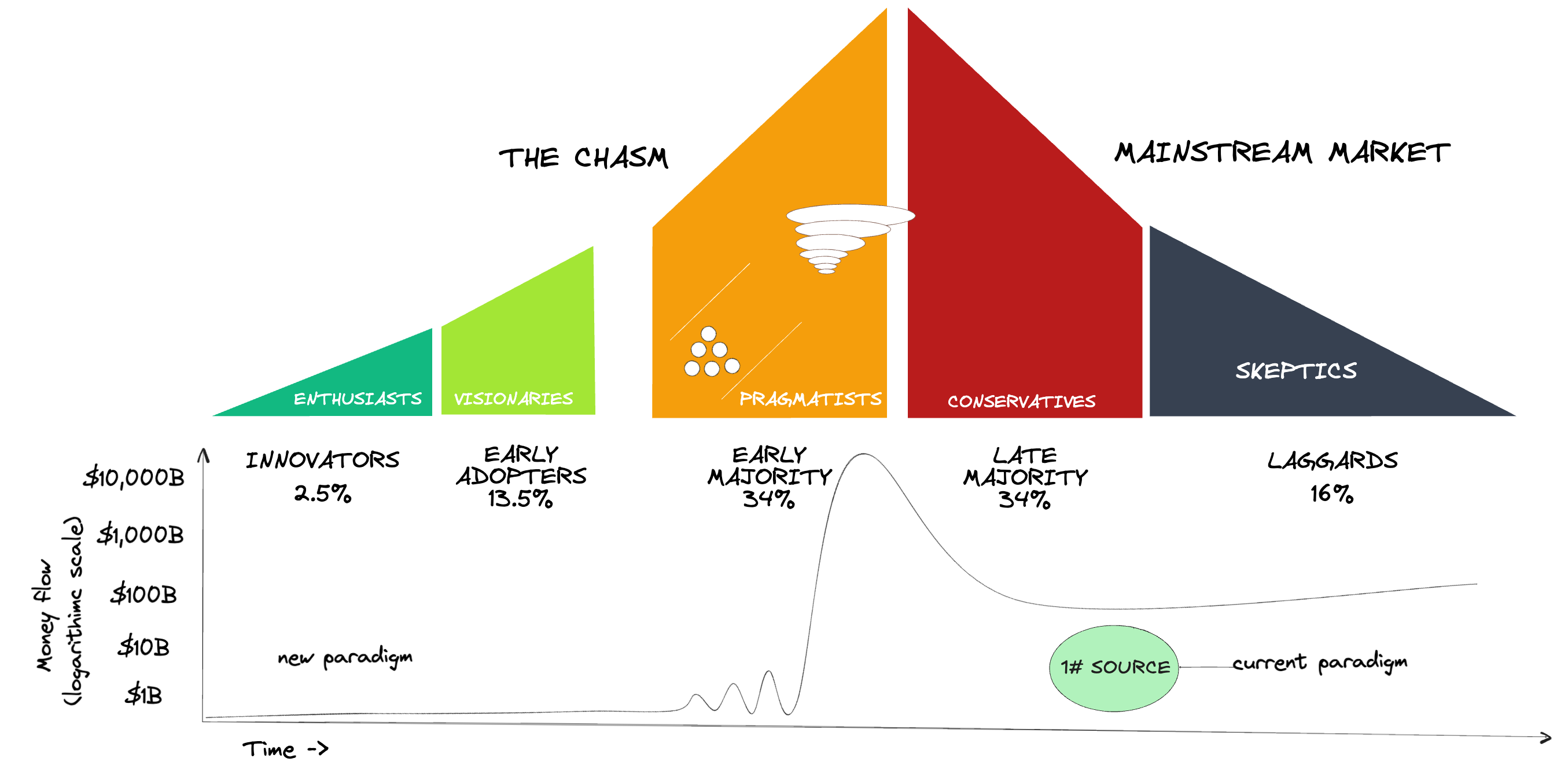
“Eventually occurs” is the defining phrase. You don’t know if it will happen, but you can monitor the market for signals. AI in software development is a prime example.
Traditional software development is a well-understood process and a very wealthy one with over $1,700B+ yearly spending (IT Services Spending: ~$1.73 Trillion by 2025 Gartner report).
Teams collect requirements, design specifications, and pass them to engineers who write the code. Humans review the result, provide feedback, and create additional requirements. This is the old paradigm fueled by billions of dollars every year.
The new paradigm with AI is still taking shape. We see products that enable non-technical users to build functional applications and AI assistants (Lovable) that serve as primary interfaces (Openclaw).
The market is clearly shifting toward new methods for building software and is 100% certain that the old paradigm can be optimized by an order of magnitude.
This is demonstrated by Anthropic, which reports that 90% of its code is written by AI, and by the countless engineers who daily share their astonishment at AI’s role in their workflows. However, they also admit that AI-assisted development still struggles with large codebases.
Does the tornado hit the brakes?
No. The AI tornado is a disruptive force affecting labor markets, SaaS valuations, and business models. Investment in AI infrastructure is expected to exceed $500B by 2026. Major technology firms are already transforming their development cycles. Y-Combinator is recruiting AI-native software agencies. There is a high probability of a total shift in the software development paradigm. The only question is:
Where will you position your agency to catch the AI tornado?
# 2. Channel: Base your Tornado Bet on concrete signals of new paradigm awareness, coming from the main market OPEX spent
A Tornado Bet must be rooted in signals that indicate where the market is heading.
In the case of AI in software development, we see an investment in AI infrastructure at scale the world has never seen. Microsoft, Google, Amazon, X, Meta are aiming to spend over $500B alone in 2026 on AI infrastructure. They are also signaling that their own growth will be based on AI-assisted workforce rather than increasing headcount.
"I will say we will grow our headcount, but the way I look at it is that headcount we grow will grow with a lot more leverage than the headcount we had pre-AI." — Satya Nadella, CEO of Microsoft (November 3, 2025)
This money invested in AI is not directly flowing to software development process but it is a signal sent by the gorillas (market leaders) that the purpose of these investments is to empower the workforce with AI to disrupt their current way of working.
Such signals form a channel towards new paradigm which core is in AI-disrupted work-processes.
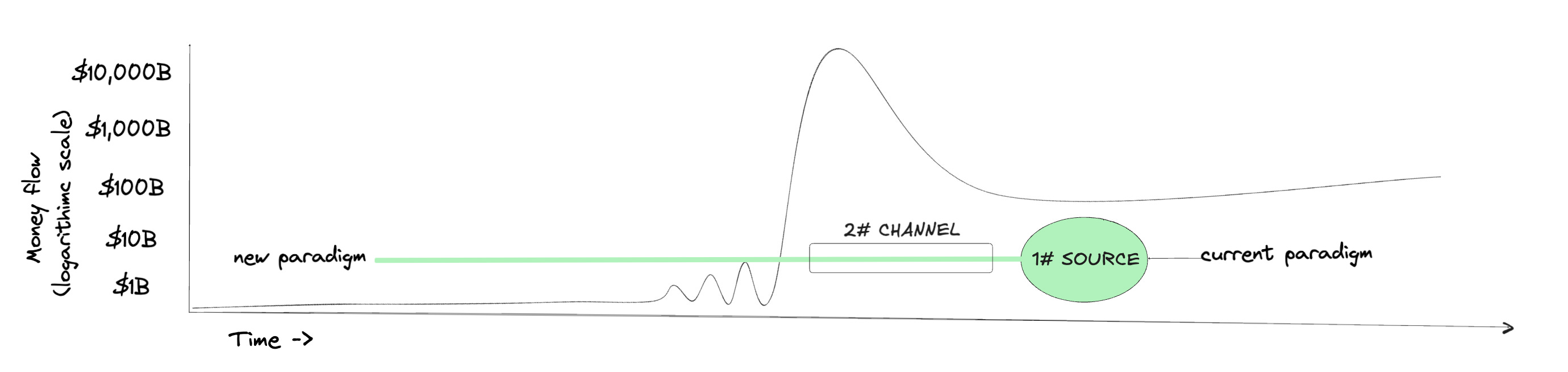
In search of a more funneled area of the channel we need to find a signal where current, mature market is already spending their OPEX on the new paradigm channel.
To me, the most revealing signal is spending on tokens.
Why is token expenditure by software teams the primary signal?
This budget is being pulled from “main-street” operational expenditures, the area where the market is currently experiencing FOMO. Spending on tokens for software development is increasing exponentially, while the AI technology itself becomes significantly more capable. The AI tornado is tearing OPEX apart to predicted $15B spent in 2026 only on tokens!
Tokens are spent by developers who are disrupting their software development process with AI. They are applying to refactoring, prototyping, but also to new modules and whole systems. Here however we see a lot of friction, because current AI solutions are not capable of delivering complete, scalable, well-architected, DRY, SOLID code. Here, our developers, who were our innovators become our skeptics.
# 3. Wedge: Resolve a survival threat to unlock the tornado
The product at the heart of your Tornado Bet must resolve a survival threat that is preventing the current shift from reaching full power.
What is currently the primary obstacle for AI-assisted software development? what is the main job of the software developers which AI can’t help yet?
Production readiness.
Engineers are not yet ready to rely on AI-generated code for production systems. The most effective way to gain their trust is to provide the working code as open source.
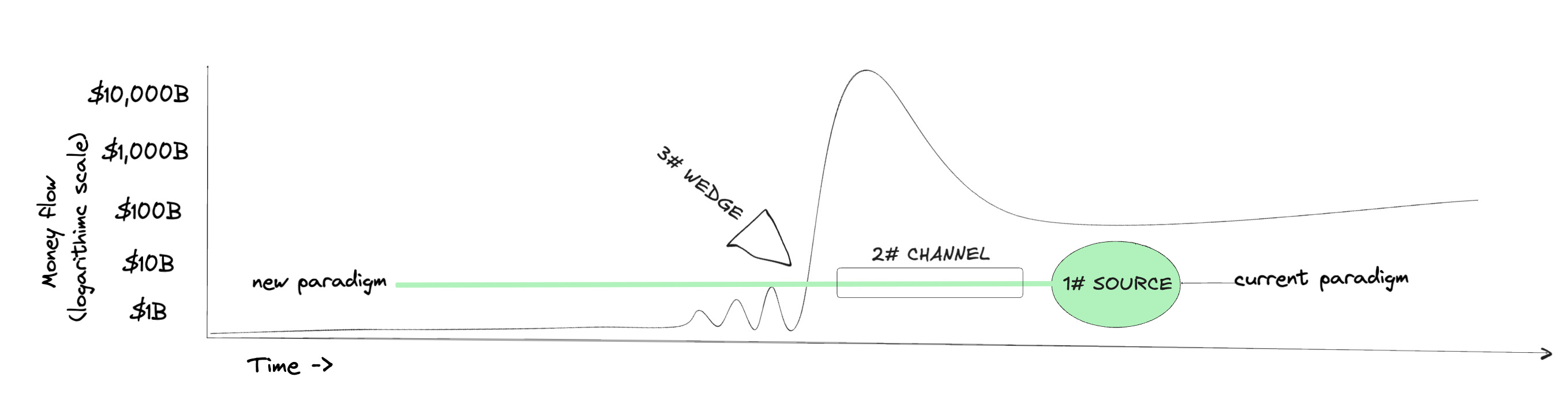
This is potential wedge of your Tornado Bet. An open source technology focused on enabling software development teams in building production-grade systems 100% by AI.
# 4. Transformator: Tornado Bet has to be rooted in new paradigm that gains main street acceptance and has high chance to transform old way of working into new one
A Tornado Bet must assume a new paradigm that will eventually replace the old one. You must choose a model that the main market will eventually accept. Our innovative developers who have agentic IDE in their hands with unlimited tokens are thinking hard, every day, how to use this tool wisely…
Think in reverse: what kind of paradigm will main-street companies accept? These organizations are often wary of risk, security, performance, and legal complications.
Do you believe they will allow AI agents to rewrite their entire software stack without human oversight with Openclaw?
That scenario might eventually occur, but it will not replace the current paradigm immediately. It is too risky; technical leaders and skeptics will argue that autonomous code is impossible to review.
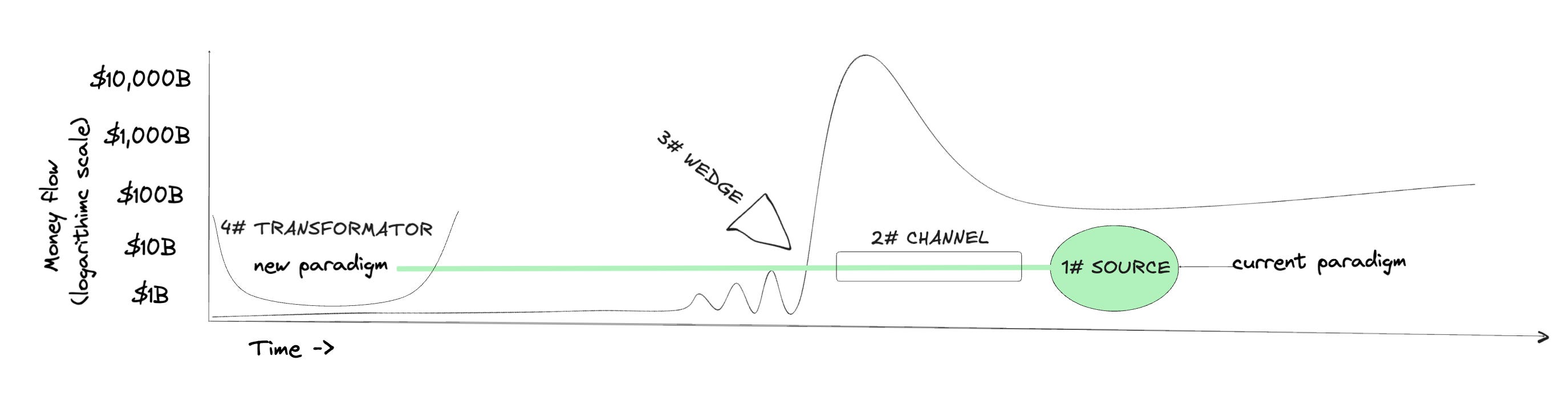
A more realistic path is that the community of senior technical leaders will trust products that align with their mental models and respect programming principles and architectural patterns. This is the promise of AI-assisted frameworks.
This is the core hypothesis behind Open Mercato:
that main-street technical leaders will trust such AI-assisted framework rather than an agent that codes without clear constraints. In the new paradigm, engineers will orchestrate software agents to build software using AI-assisted frameworks.
Will this hypothesis hold? Adoption is the deciding factor. If Open Mercato crosses the chasm and becomes a valuable alternative to custom or off-the-shelf software for a specific niche, pragmatists in the main market will choose it over purely agentic approaches.
Main-street organizations already rely on open source. By providing an AI-assisted framework certified by the open-source community, we enable technical leaders to “eat the cookie and have the cookie.”
They maintain control over the architecture while leveraging AI to its full extent.
What can your software agency do with this knowledge today?
First, you should focus on the use case of AI-assisted development for production systems. This is the “holy grail” that will unlock the full power of the AI tornado and position your company to ride the new waves. Every IP you create that helps software developers in their transformation of their current work approach to AI-assisted and ready for production - is a good bet.
What does that look like in practice?
You don’t necessarily have to contribute to Open Mercato. You can follow the example of Callstack, which released React Native skills files to the community to support developers in their transition to AI-assisted workflows. Now, any React Native developer can enhance their skills using Callstack’s expertise by integrating those files.
You don’t have to sell PoCs in Lovable; you should focus on production-grade systems. If your primary background is in e-commerce, determine how technical leaders in your segment are adopting AI. Review their blogs, posts, and articles. This is a powerful way to build relationships with major firms that are learning this new paradigm alongside you and may have less time to focus on doing it correctly.
Avoid shifting into a product company; that is often a mistake for a software agency. Your core strength is being a service-oriented company. You simply need to rethink how you deliver those services. If you continue to sell hours, you miss the AI advantage which can command premium rates you wouldn’t otherwise be able to charge. This is the “Service Paradox” that Tomek Karwatka recently explored. He argues that the traditional agency model is often a trap, but it can be transformed into a calm, durable, and high-value business if you stop competing on hours and start delivering as a strategic partner. You can read his full take on The Service Paradox here.
Many agencies will try to pivot their strategy and fail because they will treat this as a technical upgrade, not a strategic shift. They will adopt Cursor, but stay in the “deliver hours, not results” mindset. They will fail to become a true AI-native Agency.
Don’t pivot blindly and review your strategy to position yourself in a right place. Feel free to contact me for a free consulting call.