


This is an english and updated version of original polish article written in SH Growth Engine.
You're about to kick off another meeting with a prospect who, on paper, looks promising. The company fits your ICP (Ideal Customer Profile), and the person, at least on LinkedIn, appears to be a decision-maker. The agenda? A chat about your case study that featured a CTA like "Let's talk about your project."
You're all set.
You've come armed with notes, a slick presentation, and you're holding back the pricing details until the end. You try to showcase your expertise while concealing that you did the same case study project two years ago, and it fell through because the client bailed at the last minute, leaving some unresolved issues. Throughout the conversation, you're scanning for any objections, mapping the client to your sales process, and figuring out which stage of their buying journey. After 45 minutes of chatting, you're left wondering what's next. The client asked about the past project but never broached pricing, and you're hesitant to jump the gun. So you ask: "What's your next step?"
After a moment's thought, the client says the famous Hollywood theme:
"We'll discuss it with our manager and get back to you."
- Client who never got back.
When you timidly ask when you might expect a response, you hear, “He's on vacation right now; perhaps we'll know more when he returns." You exchange well wishes for the week, and the call wraps up.
Back at your desk, you pore over your notes, trying to summarize the call and honestly evaluate the BANT criteria. Soon, you start to rationalize:
Budget: Well, they did mention they already have a budget planned for this year and have set something aside for this project, so “B” checks out.
Authority: You spoke with the department director, who mentioned that talking to the C-level is more formal, so “A” is also in the bag.
Need: Do they have a need? Absolutely! They recited how they currently operate and what needs to change, so they definitely need our software.
Timeline: This is the tricky part. “This year” isn't very concrete, but hey, I've got BAN, just missing the T. So you log the deal into Pipedrive as “hot” to ensure you follow up every morning with your team and push it forward.
This scenario has probably played out for many of you, including me. As you read it, you're likely already thinking about what could've been done better. Perhaps you should have pressed harder about budget and timeline, or asked that question:
"What will happen if in six months you haven't had this project delivered?"
Maybe you needed to delve deeper into objections…there are so many things you can do better!
Three Important Truths About Client Interactions in Sales
1. None is on this call for fun
Neither you nor the prospect is on this call just for fun. The act of someone devoting their time (especially someone labelled “A”) is a strong signal. They need something. Often, our "A prospects” aren't just after advice; under the guise of asking questions about your experience, they're analyzing whether you're the right partner for them. It's about how you talk about your projects, whether you signal "We did this for that client.” or "We build these systems for market X; this project was for client Z." The prospect showed up because they preliminarily valued you enough to spare their time. That's the foundation.
2. Your client knows less than you
Assume that in 90% of cases, your potential clients don't fully grasp the problem you solved for another company. I've often seen the need to justify ourselves, a sort of anxious, even condescending portrayal of our company as "still learning, with interesting experience, but with a long road ahead." Don't do that. First, because “Mr. A” came to you because he believes you're worth his time, playing a weak card tells him, "You're mistaken; we're still just learning." Second, as I mentioned, most potential clients start from a low awareness level, and your existing knowledge is far more valuable than you might think.
3. You are not in the right seller profile
We want to be natural on the call. We want to feel comfortable with ourselves, therefore we don't care about our hat or profile we wear on the call. Unfortunately there is a dramatic difference in the efficiency of your sales activities if you are in the wrong profile. "The Challenger Sales" book documented a few seller profiles:
The Hard Worker. Goes the extra mile, doesn’t give up easily, is self-motivated and likes feedback and development.
The Relationship Builder. Builds strong customer advocates, generates customer loyalty, is generous with giving their time to help others and gets along with everyone.
The Lone Wolf. Follows their own instincts, is self-assured and independent.
The Problem Solver. Is reliable, ensures all of their customer’s problems are solved and is detail-oriented.
The Challenger. Has a different view of the world, understands the customer’s business, loves to debate, pushes the customer to get out of their comfort zone.
Check your seller profile. If you're anything other than "The Challenger,” consider why you approach meetings the way you do.
In my case over the years, I've primarily been a natural Challenger, though I sometimes slipped into "The Hard Worker" and tried to win the client heart with extreme ownership on their project. Thanks to my natural knack for developing new concepts on the fly, I smoothly transitioned between these styles but being a Challenger is more than just tossing out creative ideas. It's a process where we deliberately use our experience from previous client pains, similar to our current prospects, to shift their perception of their situation.
The “Challenger Sale” methodology consist from three stages:
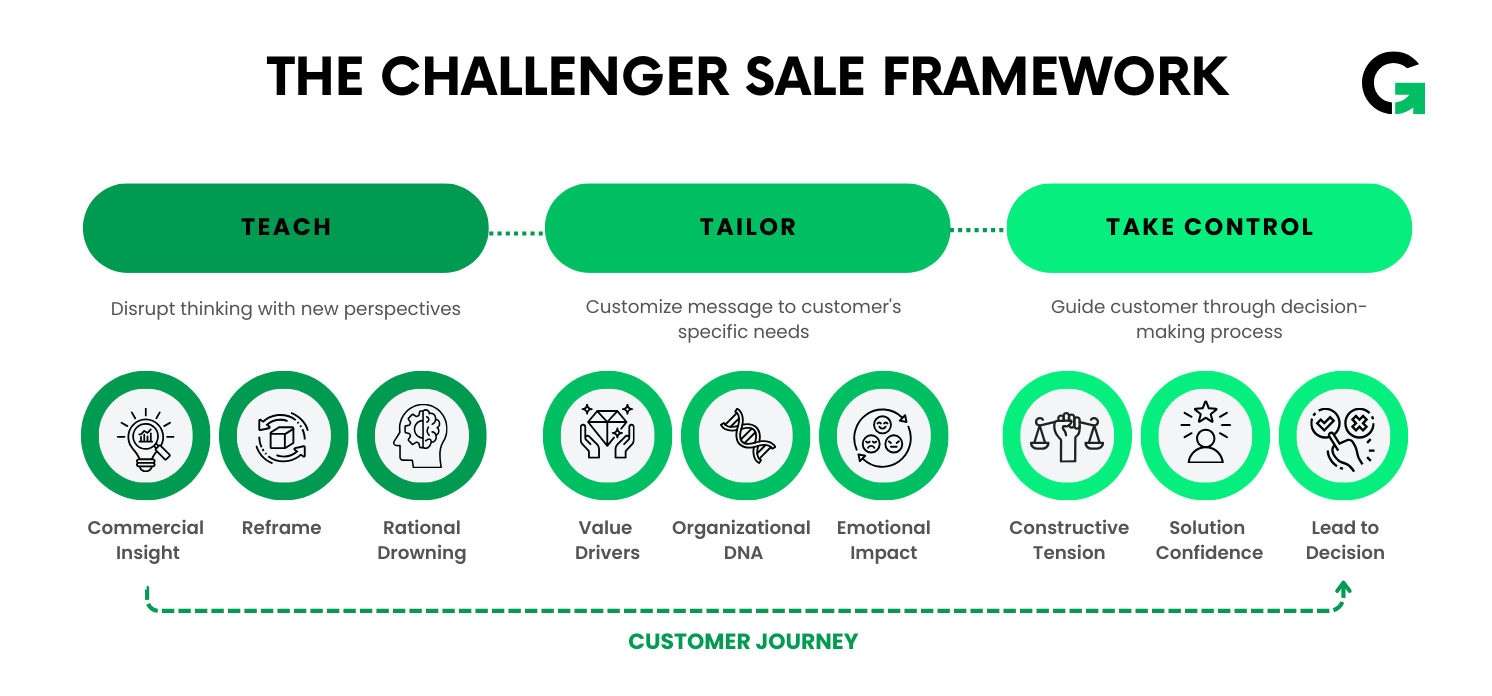
In this article we focus on the Teaching stage because this is the very first place where most of Sales people in Software Houses make biggest mistakes.
The Warmer: Setting the Stage
In the "Challenger Sale" methodology, the Teaching phase begins with "The Warmer." It's a somewhat misleading term because many interpret it as simply getting the client to feel comfortable with you. This often leads salespeople to fall into the "Relationship Builder" profile, which isn't the intent.
Effective warming isn't about building rapport through casual jokes or finding common LinkedIn connections. Instead, try these tactical approaches:
Research roles thoroughly before the call. When introductions begin, verify what you've learned against what they share. If there's a discrepancy, ask a question that demonstrates your understanding of their position in both the process and organization. For example: "I noticed on LinkedIn that your company is building a new team. I imagine your role involves deciding whether to develop internally or bring in external expertise?"
Demonstrate business intelligence. After introductions, strategically reference your research by discussing their business model and how you believe they're looking to enhance it with your assistance. For instance: "I see you're expanding into several new markets. Is this discussion focused on adapting your system for the Brazilian launch?"
Even if the prospect responds with "No, we're actually..." you've already elevated the conversation. You've moved beyond discussing immediate steps to establishing a broader perspective. This creates the latitude needed to identify the frame they've placed you in, grasp it, and effectively reframe it.
The goal isn't to build a friendship - it's to establish yourself as a knowledgeable equal who has done their homework and understands the business context. This foundation makes your upcoming insights and challenges far more credible and impactful.
Draw a New Frame
Again, in 90% of cases, your prospect isn't fully aware of how dire their situation really is. By showing them the bigger picture, uncovering deeper connections and their impact on the company and their role, you open them up to new possibilities and solutions. This is the so-called "reframe" stage, where the goal is to anchor them with one pivotal insight that opens up a broader or entirely new horizon.
The "Challenger Sale" methodology offers several reframing techniques: connecting to larger business problems, revealing hidden costs, identifying future risks. But how do you get into those topics so quickly? Remember the first lesson: no one is on this call for fun. They are highly paid executives who sit in front of you (most likely virtually) because in the back of their head there is this "big thing" that keeps them awake.
What works for me is using The Warmer stage, especially the "business model discussion," to identify what kind of business objectives your client has. Keeping the high latitude I've gained after properly setting up The Warmer phase, I keep wondering in the sky with them, looking at their challenges like small buildings from an airplane, trying to find their place in this picture.
Almost every day I have such calls with clients, and eventually all reframing techniques from the "Challenger Sale" methodology point to one basic question:
Why are you wasting your time with me today?
Of course you shouldn't ask this question to your client, but you should keep asking this to yourself. Every hypothesis you think of that is valid can be instantly verified by simply dragging the client between questions. Often, because you're aiming for the right spot, the client is more than happy to answer. This is their reason for sitting here, and having someone who actually understands that is certainly very refreshing.
Climb the Hill and Show the View from the Top
At this point, we move into what's known as "rational drowning." This is an ethically crucial moment. We aren't trying to manipulate; we want to educate about the problem. After the reframe phase, where we help the prospect realize their issue is broader than they thought, the "rational drowning" phase anchors them to real, long-term problems- the view from the hill.
Since the prospect isn't fully aware of their issues in 90% of cases, we present them with a factual picture based on our expertise. Ethically, this is very important because we might veer into problems that aren't critical for the prospect but fit our solution. So, you need the courage to explore with the prospect whether these expanded problems truly affect their goals and needs during the rational drowning phase.
What helps is a well-crafted narrative that illustrates:
How a previous client struggled with the same problem
The tangible costs: wasted time, lost money, depleted resources, and inefficient processes
The genuine pain points they experience daily
This narrative helps prospects emotionally connect with your process, even before you present your complete solution.
Notice that I've taken a similar approach in the introduction of this article and am following that methodology as I write. This is the first phase of the Challenger Sale process, which we call Commercial Teaching. As you can see, we do not give away our knowledge for free. We use our knowledge as leverage to open our client's eyes to new horizons and reposition our conversation on an equal level.
The Commercial Teaching stage also gives us insights about the Value Drivers, Organization DNA (deeply understanding the client's unique organizational culture, power structures, and decision-making processes) and Emotional Impact (individual concerns, aspirations, and pain points). The Commercial Teaching is foreplay that outlines the data you can use to tailor your offer and pitch to the client.
Here's the brutal truth: We are afraid of dynamically changing our offer during the call. We would like to sell the same thing, tell the same story, and win every time. That's where Commercial Teaching efforts can go to waste in a second. Get out of your own frame and draw a service that is a new version every time, tailored to what you've heard. It's not cheating - it's teaching your client how your service can best serve them by simply linking what you've learned to it.
You have no idea how many times I see this happening on the call. Big company, great sales guys who are just pretending to listen to you but in the back of their head I see already “Our Offer Slide no 5” opened, just waiting for me to look at it.
So, Why Do We Sell Ourselves for Free?
We don’t have many good workshops for B2B IT service salespeople in Poland. We all learn as we go. Due to our cultural baggage, we often enter meetings with the "Hard Worker," "Relationship Builder," or “Problem Solver" mindset. The issue with these approaches is that in complex B2B IT services sales, we try to win the client by giving away tons of knowledge, advice, and even help.
In doing so, we sell ourselves for free.
We assume that by helping and being brutally honest, we'll win the prospect's heart. Unfortunately, prospects need something else:
They need a solution
They don't want to feel like they're being tested or forced to take a risk
They're genuinely searching for a solution, not more problems
Bombarding them with knowledge on how to solve the problem on their own doesn't help either. Either they use that knowledge to sort it out themselves, or end up even more confused.
How to Stop Giving Away Your Expertise for Free and Start Selling Your Value?
Protect Your Expertise
Don't give away the know-how to solve the problem for free. That expertise is your asset. You've honed it on past projects, often at the cost of margins, nerves, and sleepless nights. It might seem obvious to you, but it's pure gold to others.
Present Your Solution as a Process
After “rational drowning” stage, after you share a "life story" about another client (one similar to them) and assuming you hit the mark, you then present your process. This is the beginning of “Tailor Phase” of the “Challenger Sale” methodology. You don't show them just the software; you show them the process that ultimately delivers a software solution built by you.
Other important outcomes of the presented process include:
Implementation and staff training
Achieved KPIs
Other needs are directly tied to the highlighted problems
This process might be broken down into 7 steps or blocks (something simple and easy to understand) that ultimately give your prospect the desired feeling, state, or result. The software is just one element.
Don’t forget to tailor it! what it means? you take all the findings from the “Commercial Teaching” phase and wrap them around the process. Example:
your client said that they are lacking tech leadership to scale their team? put an emphasis on the knowledge sharing, technical leadership, best practices of your own services. The “Tailoring Phase” is much more than this and we will follow-up in another article on it.
Avoid the "Outside Our Scope" Trap
If in your solution, you often have to say, "Oh, that's outside our scope" (for example, legal/compliance matters), assume that every time you do, it's like telling the prospect, "Don't buy from us because we don't cover that." Instead, reframe it positively:
"Compliance with current regulations is a comprehensive service we deliver in partnership with X"
"At the right moment, we'll guide you through that process"
Sounds better? And at the same time, you're earning a success fee.
Escape the "Friend Zone" with Prospects
I've often heard from SH salespeople that a prospect is "hopeless" because they talk a lot, but nothing ever comes of it. It's a bit like that guy stuck in the "friend zone."
The Friend Zone Analogy:
He's head over heels for the girl, but she treats him as a "buddy"
He cooks for her, takes her to the movies, showers her with compliments
She appreciates it, but doesn't want a relationship
With prospects, every call is like serving them a free meal. A Challenger has the guts to say:
"I really like you, but let's define our relationship"
"If we're in it together, I'm ready to commit"
"If we're just friends, let's set the rules, like splitting the bill"
Of course, you need to choose your words carefully, but to a prospect, it might sound like:
"I'm really excited about our next meeting. We're currently gathering requirements, a phase that will take a few more weeks and involve several people from our company. I'm thrilled to potentially work with your company because you're a well-known brand. But first, I'd like to establish how our investment can pay off later, for instance, when we execute a joint project. Could we discuss this further with you or the decision-maker?"
As you read this, you might think, "Great, I'm about to scare them off." If that's the case, ask yourself whether you've already lost them and are doomed to the "friend zone," while someone else is already going on "dates” with your client. Gathering requirements and creating a beautiful document, without (heaven forbid) a signed NDA protecting your IP, is nothing more than providing the client with free fodder for an RFP they might send to companies like yours.
The True Purpose of Commercial Teaching
As you can see, Commercial Teaching is all about:
Educating the client on their problem
Building a trust platform where they let you lead them
Discovering data about clients’ values, DNA, and personal/emotional goals to reposition your company more towards their needs
It is NOT ABOUT teaching clients how to solve their core problem on their own. That's what you and your paid services are for.
While this article has focused on mastering the Teaching phase, remember that the complete Challenger Sale methodology continues with Tailoring (customizing your message to different stakeholders) and Taking Control (guiding the customer through the purchase process). But without a strong foundation in Commercial Teaching, the subsequent phases won't have the same impact.